
![]()
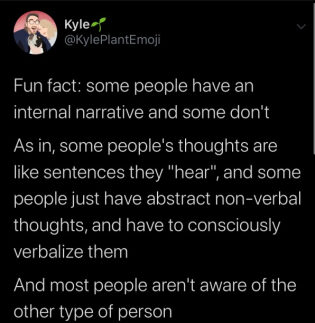
My day was completely ruined yesterday when I stumbled upon a fun fact that absolutely obliterated my mind. I saw this tweet yesterday that said that not everyone has an internal monologue in their head. All my life, I could hear my voice in my head and speak in full sentences as if I was talking out loud. I thought everyone experienced this, so I did not believe that it could be true at that time.
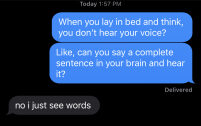
Literally the first person I asked was a classmate of mine who said that she can not “hear” her voice in her mind. I asked her if she could have a conversation with herself in her head and she looked at me funny like I was the weird one in this situation. So I began to become more intrigued. Most people I asked said that they have this internal monologue that is running rampant throughout the day. However, every once in a while, someone would say that they don’t experience this.
![]()
My life began to slowly spiral out of control with millions of questions. How do they get through the day? How do they read? How do they make decisions between choice A and choice B? My friend described it as “concept maps” that she sees in her brain. Another friend says that she literally sees the words in her head if she is trying to think about something. I was taking ibuprofen at this point in the day because my brain was literally unable to comprehend this revelation. How have I made it 25 years in life without realizing that people don’t think like me?
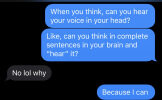
I posted a poll on instagram to get a more accurate assessment of the situation. Currently 91 people have responded that they have an internal monologue and 18 people reported that they do not have this. I began asking those people questions about the things that they experience and it is quite different from the majority.
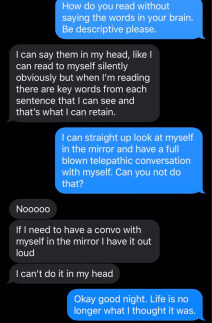
I would tell them that I could look at myself in the mirror and have a full blown telepathic conversation with myself without opening my mouth and they responded as if I had schizophrenia. One person even mentioned that when they do voice overs in movies of people’s thoughts, they “wished that it was real.”
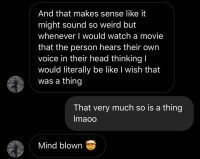
And to their surprise, they did not know that the majority of people do in fact experience that echoey voice in their head that is portrayed in TV and film. Another person said that if they tried to have a conversation with themselves in the mirror, they would have to speak out loud because they can’t physically do it inside of their mind.
I started posting screenshots of these conversations on my instagram and my inbox started
to flood with people responding to my “investigation.” Many people were reassuring me that I was not crazy for having an internal monologue, while others were as absolutely mind blown as I was. People were telling me that I ruined their day and that they now do not understand anything about life. Maybe you are all just a figment of my imagination, but regardless, yesterday made reality seem even more skewed.
How do they think? How does this affect their relationships, jobs, experiences, education? How has this not been mentioned to me before? All of these questions started flooding my mind. Can those people without the internal monologue even formulate these questions in their mind? If they can, how does it happen if they don’t “hear” their voice? I mentioned earlier that I was spiraling out of control. Well, as I write this and as I hear my own voice in my head, I am continuing to fall down the rabbit hole.
![]()
Whether people just have different definitions of their thoughts, or if people literally don’t have an internal monologue, there is one thing that we do know… you will definitely get a headache if you keep thinking about this. Just trying to wrap my head around it is causing irreversible brain damage. I suggest asking people around you what they experience. If you are one of the few that do not have this internal monologue, please enlighten me, because I still do not understand life anymore. Send help.
@RyanLangdon_
This is extremely interesting. I have multiple ways of conversing with myself. I have internal dialogue at times but other times the words don’t come to me and I need to talk aloud to myself. Sometimes it’s a series of visual pictures or scenes that I need to play out, but I never just see a word. I think it has to do with having a more scattered brain, it doesn’t think in 1 way. Interesting to read everyone’s comments!
LikeLike
I am like this as well. I’ll drive my husband bonkers because I’ll say something out loud making him think I’m speaking to him when I’m actually just thinking out loud. And I as well am a bit scattered brain.
LikeLike
interestingly this topic came up in an acting class many years ago..and since then I think that pictures are still there its just that words or reassuring sound of the words overlays. The tutor called it a ‘running commentary’ and also asked the girl who brought it up if they grew up in alot of fear…she said yes. I did too. Now I’m not saying it applies to everyone…how would I even know, but i am just wondering. I also think one can look for the pictures behind the words and learn to think more in pictures. They are there. Interesting that some people have a bit of both. Visualizing things is quicker, more healthy even? I’d like to think we all have this ability. Maybe just something we need to focus on, to improve a bit? I believe it has helped me be more creative and get more things done too.
LikeLike
About this whole “internal monologue” thing: no-one seems to be looking at the aspect of groundedness, or presence. When you’re totally present, no thought can arise. You just react as you will, without any internal dialogue or monologue coming into it at all.
Let’s say something smashes the window right next to you. In instant of the sudden shock, you don’t immediately start an internal monologue. That may happen a few seconds later, but at first there is only your full and present sensory attention. In the same way, a beautiful scene in nature, a magnificent sunset, may bring us for a few seconds into a state of total presence. There are no thoughts, no monologue for that brief interval.
A thought is always connected with the past or future. In the immediate present, thought cannot find a foothold. If we’re able to practice presence, able to become more aware of the constant immediacy of the present moment experience, we may be able to move beyond the constant internal monologue situation, and into “flow” – that is, into just doing what we do as it unfolds, without the need to stand outside of it and think about it.
LikeLike
Wouldn’t standing outside of oneself and thinking about it actually be more present then just reacting to everything like a machine?
LikeLike
Great comment except maybe one thing…if you are reading to yourself is your “talkative” mind not in sequence with the present?
LikeLike
How does someone pray if they don’t have an internal monologue? Without mouthing the words outloud? Or practice a speech in your mind?;
LikeLike
Perhaps (western style) prayer is the sort of intentional internal monologue that differentiates between some of these ways of thinking. You are “talking”… silently… to someone/something not physically present… Sort of like Bob Newhart’s one-sided telephone conversations… but anyway, you’ve “externalized” a silent partner to “speak” to. I dunno. Confusing.
LikeLike
Wordless prayer is an old theological standard. I think there have been many people who think without words, either visually or (in my case) in abstracted …ummm… meanings or in other ways, who can link concepts in mind-space and push the totality of the linkage outwards with yearning. Or sort of plop it down into the metaphorical arms of the gods metaphorically in front of one, this lot being up to them now.
LikeLiked by 1 person
I do have a constant inner narrative, but can’t talk directly with myself in my head, so my mind has to make up someone to talk with 😀 Most of the time it’s an actual person that I know in real life, or someone I don’t but anyway I can imagine the way they would answer. For discussing problematic things I prefer to “turn to” someone who would be likely to have a wise word for me (a well-known scientist, or the Dalai Lama or similar) and quite often this thought process brings very surprising and satisfying results :O
LikeLiked by 1 person
I didn’t read all 2000+ comments, but has anyone yet asked and responded to this question: How does one without the internal voice pray? For me the inner-monologue type, at my very best, I am speaking to God in my mind while simultaneously envisioning myself in His Presence. At my worst, I am praying a repetitive prayer like the Rosary – repeating 50 Hail Mary’s either out loud or IN MY HEAD WHILE thinking about what I should cook for dinner (or worse). I wonder if there is something to be learned here in praying “from the heart” and not with just words.
LikeLike
Just when you thought things couldn’t get worse. I don’t hear sounds in my head, not even when I am trying to remember a song, I also can’t imagine images so there are no pictures in there either. I often joke when someone asks what I’m thinking about that there’s nothing going on upstairs, just blank.
LikeLike
This book really helped me with quietening the voice – The Untethered Soul: The Journey Beyond Yourself
by Michael Alan Singer
LikeLike
It was an interesting reaction piece, and an interesting interview. Thanks.
Taking up the point that the interviewee reads while moving her lips, and talks aloud to process thoughts in words, some reader may find this of interest:
Many slow readers have to move their lips, or at least subvocalize (as I do when typing, with tiny twitches of the speech muscles) and link the words with their mental concepts as a separate link via the word’s physical action. It sounds as though this is so in her case. It also seems that her concept storage can be accessed and manipulated nonverbally., and linked to words as a separate process.(She knows the shape of what she wants to say, but not what the sentences will be.) I wonder whether the concepts “feel” like words to her?
Some very fast readers (my case) get faster than auditory processing speeds by disconnecting the vocal movement centers from the reading process. With much reading in this form, I started reading directly to the mental concept. (I have to switch back to subvocalization to “get” poetry.) It is very interesting when an author drops in a malapropism, as the error correction starts witb a mismatch of received vs expected concept. I know it is not skim-reading, as minor punctuation errors and typos are detected by some part of the process, which also drops in suggestions of better ways to sequence and word the piece.
Possibly as a result, much of my thinking is in abstract (non-speech, image, or sound) concepts, mental representation of physical feelings and actions, and logical linkages. When I am thinking for communicating, the linkages include meaning-groups and sound-groups which some process whittles down to make word-choice. I think it made second language learning easier for me than for those who access and process meaning through the physical representation. I can use internal monologue when I choose, but it is just me, even when I take all sides of a complex debate. What I can nearly never do is visualize: I am nearly aphantasic, and was surprised to lean that people cansummon images, and have memories like movies or being there again. (Explained why I had trouble drawing until a teacher of teachers gave us the physical thing to draw!)
A database, financial processing, and site back-end design IT engineer I know (Footnote: He says he can think in words when he chooses, but I know he had to translate from nonverbal thinking to his first language as a school child. He was known to have concepts before a word was available to express it.) says that in his work he also thinks non-verbally, in multidimensional linkages of concepts and interlocking processes. We both say these can’t really be called mind-maps, as experience shows that it is not really possible to put 4-or-more-dimensional processes onto the 2-D paper surface. A professor of higher mathematics, working in N-dimensional shapes, similarly did much of his work in pure concept and process linkages.
So it’s not just physical matters which can be – or even are best – thought about nonverbally.
LikeLiked by 1 person
This is the comment that I can most relate to. I also do not verbalize in my thoughts. Although I describe it more like images or sybols in my brain. I don’t “think” words. Not sure what that says about me. Just the way I am.
LikeLike
Subvocalization is the official term for silent, internal speech. There is research on the topic, much of it within the study of Linguistics and Cognitive Science. The Oxford Book of Reading discusses subvocalization in some depth as it pertains to reading and linguistics.
I am often told that I am an audible processor, as others observe I think and read out loud rather than internally. However, most people don’t know that I DO process and speak internally. It seems I use both methods. This is curious and confusing for me when I hear people say they do one or the other. I am able to choose which process method I use, and i use them for different purposes. I imagine there are more people who process like me, i just don’t know it yet! I would be curious to know more about this topic.
What percentage of people use inner versus outer thinking/speech? What percentage of people can access and use both methods? Is the choice between the two random or intentional? If intentional, why does an individual choose inner or outer? and does this selection increase the success of whatever task it is applied to?
So much to ponder. 🙂
LikeLike
I do both. Monologue guided by internal, vague notions of ideas that lead from one to the other and may manifest visually or in sound — like a dance of cognitive content where the monologue acts as a grounding element. This sort of shit is hard to communicate. Half the time my verbalisation is so abstract that people dismiss me as up in the clouds.
LikeLike